
Consumers have more access to information than ever before, yet confidence in what they see online continues to erode.
Feeds are saturated with sponsored content. AI-generated creative blurs the line between authentic and synthetic. Deepfakes, bots, and automated persuasion have made digital environments feel increasingly unstable.
This erosion is not theoretical. It shapes how people interpret messages, how quickly they dismiss claims, and how skeptical they are of brands they encounter online.
In this environment, trust is no longer a given.
The Shift From Attention Economy to Trust Economy
For years, the dominant narrative in advertising centered on attention.
Who could capture it. How cheaply it could be acquired. How efficiently it could be converted.
That framework is breaking down.
As attention becomes abundant and fragmented, trust becomes scarce. Consumers may see thousands of ads, but they believe very few. This shift reframes the challenge for brands. Visibility alone is no longer enough. Presence must feel credible. Messages must feel grounded in reality rather than manufactured for optimization.
OOH is uniquely positioned to meet this moment.
Why Digital Trust Is Eroding
Digital advertising has not lost trust because it is ineffective. It has lost trust because it feels increasingly artificial.
Algorithms decide what people see. AI generates content and headlines at scale. Optimization prioritizes engagement over substance. The result is a stream of content that feels designed rather than lived. As AI advances, this sensation intensifies. When consumers cannot distinguish between human-made and machine-generated content, skepticism becomes a default response.
This does not mean digital advertising will disappear. It means its influence will be filtered through doubt.
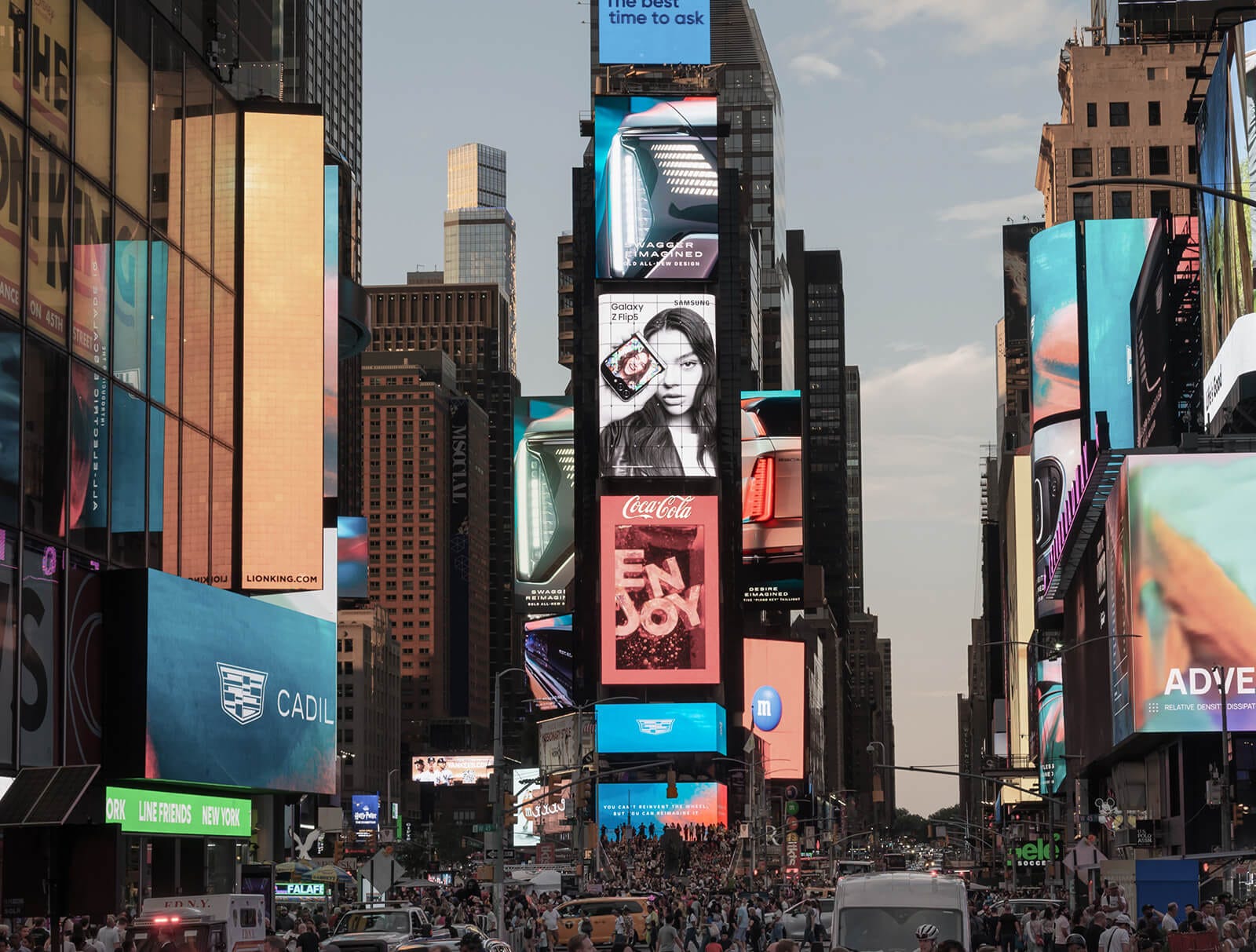
Trust has quietly become one of the most valuable and fragile assets in modern advertising.
Physical Presence Signals Legitimacy
A billboard, a transit placement, or a venue screen exists in the physical world. It is not generated dynamically. It does not disappear when you scroll. It occupies space that everyone can see.
OOH exists outside this ambiguity. This physicality carries weight.
To show up in real space, a brand must commit resources. It must choose locations. It must exist publicly rather than algorithmically. That commitment signals legitimacy. Consumers may not articulate this consciously, but they understand it intuitively.
Trust Is Reinforced Through Shared Experience
Trust has quietly become one of the most valuable and fragile assets in modern advertising.
One of the most powerful aspects of OOH is that it is experienced collectively.
People see the same message in the same place. They reference it. They recognize it together. This shared exposure creates social validation.
Contrasting to digital, where digital advertising is increasingly individualized. Two people in the same room may see entirely different brand messages. There is no shared context.
And can you trust the deliverability itself? With so much MFA, fraud, and clickbait, digital has lost its edge in an increasingly more aware business world.
OOH restores that shared frame of reference. When a brand becomes part of a shared environment, it feels less like persuasion and more like presence.
Why AI Makes Physical Trust More Valuable
As AI-generated content becomes ubiquitous, authenticity becomes harder to signal digitally.
Brands will produce more content than ever. Consumers will trust less of it. In this environment, physical presence becomes a credibility anchor. It is harder to fake. It feels deliberate. It resists manipulation.
The more synthetic digital environments become, the more valuable grounded, physical channels will feel.
Trust Is Built Over Time, Not Optimized Instantly
Trust is cumulative.
It is built through consistency, repetition, and reliability. It cannot be optimized in real time or attributed cleanly to a single touchpoint.
OOH supports this process by showing up steadily in environments people trust. Commuting routes. Public spaces. Cultural venues.
These are not transactional moments. They are part of daily life.
Brands that invest in these environments benefit from the trust already embedded in them.
Why OOH Will Become a Strategic Asset
As trust becomes a defining factor in brand choice, OOH’s role will expand.
It will not replace digital channels. It will stabilize them. It will lend credibility to messages delivered elsewhere.
Brands with strong physical presence will find that their digital advertising converts more efficiently. Skepticism is lower when familiarity is already established.
OOH becomes the foundation on which other channels perform.
Trust Has Quietly Become The Most Valuable and Fragile Asset in Modern Advertising.
The future of advertising is not just about reaching people. It is about being believed.
In a world where content can be generated instantly and persuasion can be automated, trust becomes the true differentiator.
Out-of-home earns trust by existing in the real world, in shared spaces, over time.
As the advertising ecosystem becomes more synthetic, the most credible brands will be the ones that remain physically present.
That is why OOH will win the trust economy.